The core of the legend
According to tradition, it was the evening of the first day of the intercalary first month of the first year of Taika (645). Stars fell from the sky, lighting the entire area as brightly as day. This strange phenomenon is said to have happened not once, but many times over.
Word of it reached the reigning emperor, Kotoku. He is said to have stayed on the mountain himself and witnessed the falling stars firsthand. He then named the mountain "Hoshi no Koyama" — the mountain where the stars dwell. The mountain's present name, Hoshinokoyama, is said to derive from this story.
Emperor Kotoku is a historical figure who took the throne following the Isshi Incident of 645, moved the capital to Naniwa, and established Japan's first era name, "Taika." The "first year of Taika" in which the Hoshinokoyama legend is set corresponds exactly to this major turning point in ancient Japanese history. The legend itself rests on oral tradition, but the fact that its historical setting is solidly documented is one reason it continues to hold interest.
Stars fell from the heavens, lighting the earth as bright as day — night after night, without ceasing. A scene from oral tradition on Mt. Hoshinokoyama (paraphrased)
In the evening, a strange shower of falling stars occurs, and repeats many times afterward.
The emperor is said to have stayed on the mountain himself, witnessed the stars descend, and named it "Hoshi no Koyama."
A later tradition also records that Emperor Shomu climbed the mountain together with the monk Gyoki.
An Edo-period gazetteer records the mountain's name, noting a hall at the summit enshrining the bodhisattva Fukuichiman Kokuzo.
On August 5, the park reopens under a new name and management.
On July 1, the park's center house opens newly rebuilt.
Carrying on the name "the mountain where stars fell," the site is maintained as a park with a campground and hiking trails.
Background of the faith
Star worship in Japan is thought to have taken shape from the Asuka and Nara periods onward, as Taoist astral worship transmitted from the Asian continent and Myoken veneration (the deification of the North Star and the Big Dipper, absorbed into Buddhism) blended with Japan's older mountain worship and nature worship. Legends describing a particularly conspicuous heavenly body being deified, descending to earth, or granting power from the sky arose across the country as this broader current of belief spread.
Among these, "Myojo" — the term for the particularly bright planet Venus as it appears at dusk or dawn — was treated as a star of special significance. In Buddhism it was also associated with the wisdom of the bodhisattva Kokuzo, and a well-known story tells of the Evening Star flying into the mouth of Kukai (Kobo Daishi) as he completed the Gumonjiho austerity. The record noted earlier — that Kokuzo (as Fukuichiman Kokuzo) came to be enshrined at the summit of Mt. Hoshinokoyama over time — can be read as one example of a pattern often seen in Japanese star worship, in which veneration of "a star" comes to overlap with veneration of "a bodhisattva closely tied to the bright star."
Another telling
A more elaborate variant of the Hoshinokoyama legend has also been passed down. In ancient Kibi Province, the heavens are said to have rumbled and the whole mountain to have been wrapped in light, again and again — until a being appeared calling itself "the Evening Star" (Venus). Wishing that "evil demons should not flourish, and that the people should prosper," it is said to have sent three bright stars down onto this mountain (called "Mt. Achi" in this version) and bestowed jewels upon it.
In this variant, Emperor Kotoku climbs the mountain accompanied by the ascetic En no Ozunu, known as the founder of Shugendo, and together they witness the Evening Star. When the emperor prays, "Let water spring forth from the peak of Mt. Achi," clear water is said to have gushed out on the third day. The emperor is said to have named the foot of the mountain "Goshogahara," built a shrine at the summit enshrining the three jewels as the "Three Jewel Deities," and named the mountain itself "Hoshinokoyama" — a more mythic version of the story. This unusual companion, En no Ozunu, is worth a closer look, taken up in the next section.
The ascetic in the variant telling
En no Ozunu (also called En no Gyoja) is a semi-legendary figure believed to have been an actual ascetic and practitioner of esoteric ritual in the late 7th century, regarded as the founding figure of Shugendo, a tradition of mountain asceticism blending Japan's native mountain worship with elements of Buddhism and Taoism. The official chronicle Shoku Nihongi records that in 699, in the third year of Emperor Monmu's reign, he was exiled to Izu on charges of deceiving the people with sorcery — confirming that he was a real historical figure — but the greater part of his life was subsequently elaborated into legend and deified in later centuries.
Shugendo ascetics treated mountains as places of training, and as they made pilgrimage circuits of sacred peaks across the country, their tradition's influence spread nationwide. As a result, it became common for the origin stories of sacred mountains across Japan — including Mt. Daisen and Mt. Ishizuchi in the Chugoku and Shikoku regions — to feature En no Ozunu (or, in later centuries, Kobo Daishi) as a character. En no Ozunu's appearance in the Hoshinokoyama variant can be read as one example of this broader pattern, in which the authority of a famous ascetic became attached to the origin story of a local sacred mountain as Shugendo culture spread.
Interestingly, some sources on Mt. Hoshinokoyama's history record that, to confirm the mysterious falling-star phenomenon, Emperor Kotoku first had En no Ozunu investigate before climbing the mountain himself. That En no Ozunu appears not only in the more elaborate variant — with its Evening Star and Three Jewel Deities — but also, if briefly, in the simpler line of the tradition, shows just how widely and flexibly this ascetic's legend came to attach itself to mountain traditions across the country.
The history of the stone tower
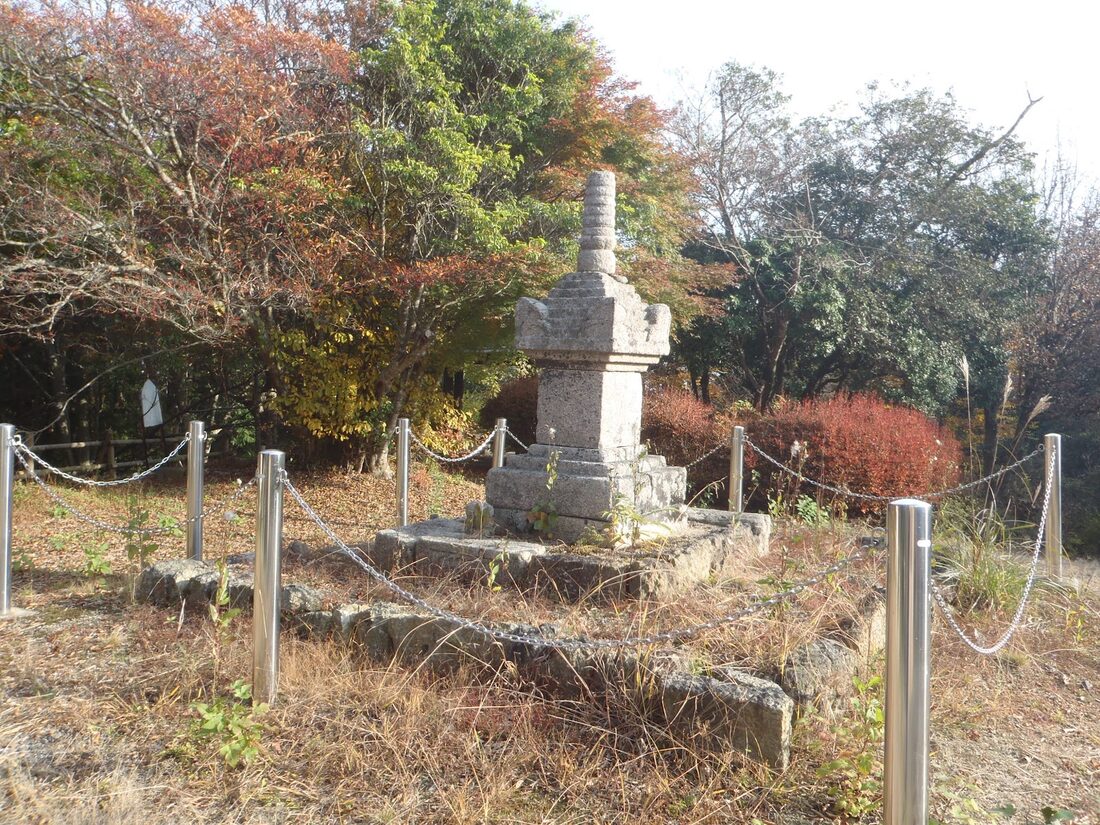
The hokyointo originated as a form of memorial stupa built to enshrine the Hokyoin dharani sutra, and was produced in great numbers in the Wuyue kingdom of China before reaching Japan by around the late Heian period. It became established as a distinctly Japanese tower form during the Kamakura period, and from the Kamakura through the Nanboku-cho and Muromachi periods it became an extremely common type of stone memorial monument, erected at temples, graveyards, mountain passes and summits across the country.
Importantly, a hokyointo is not necessarily an actual grave containing someone's remains. Many known examples were built as cenotaphs — monuments raised by believers, temples, or local communities, whether at the time or in later generations, to pray for the repose or salvation of a high-ranking monk, a person of noble status, or an unnamed deceased person. In other words, a hokyointo is, in many cases, better understood as a "monument to prayer" than as a burial site in the literal sense. Bearing this general character in mind helps explain how a single tower at a mountain summit could, over the centuries, come to be described in local tradition both as an emperor's mausoleum and as a great monk's memorial.
What stands at the summit
A stone tower of the kind described in the previous section — a hokyointo — still stands at the summit of Mt. Hoshinokoyama today. Here too, the story is not settled. Within what the town describes as "the fairy-tale-like Hoshinokoyama Forest Park, named for the mountain where stars fell," this tower is said in the town's own materials to be either Emperor Kotoku's mausoleum, or the memorial of a great monk known as Internet Shonin — with multiple theories recorded side by side.
The early-modern gazetteer Saibi Meiku records that this mountain was the tallest in the surrounding area, and that a bodhisattva, Fukuichiman Kokuzo, was enshrined in a hall at the summit. The way the object of worship shifted over time — from a star deity to a bodhisattva — speaks to the depth of this mountain's history of faith.
Comparing star legends
Legends attributing their origin to a star (or a light) falling from the night sky can be found in various parts of Japan. Hoshida Myoken-gu in Osaka Prefecture, for instance, carries a tradition that seven stars descended there, and preserves to this day a "star forest" linked in legend to Kobo Daishi's prayer. Hoshi Jinja in Okayama City is likewise known for a tradition of veneration connected to a meteorite, and some accounts link it to the ironworking culture of the Chugoku region.
These star-descent legends share a recognizable narrative pattern: a sudden light appears in the night sky; a person of high status or a religious figure is present to witness it; a place name is coined to commemorate the event; and a shrine or hall is later built on the site. This likely reflects a broader current in Japanese religious history, in which astral worship and Myoken veneration, transmitted from the continent, blended with esoteric Buddhism and native mountain worship as it took root across the country.
Traces of the legend in the land
"Goshogahara," the place name said to have been given by Emperor Kotoku in the variant telling, is said to survive today as a local place name at the foot of the mountain — a sign that this millennia-old legend has been woven not merely into folktale but into the very names people use for this land. Place names tied to the falling stars, the spring of clear water, and the emperor's ascent have all been handed down together, testifying to how deeply the Hoshinokoyama legend has taken root in the landscape and daily life of Jinseki Kogen.
Jinseki Kogen is also home to another iconic landscape alongside Mt. Hoshinokoyama: Taishakukyo Gorge. Hoshinokoyama Forest Park is itself listed as a nearby point of interest by the Taishakukyo Tourism Association, and the legend of the mountain where stars fell and the living tradition of Taishakuten worship in the gorge make for two very different divine stories from the same corner of Jinseki Kogen — well worth visiting together. For more on the gorge and its deity, see Taishakukyo & Taishakuten.
Mt. Hoshinokoyama today
The area around Mt. Hoshinokoyama is now maintained as Hoshinokoyama Forest Park, named for "the mountain where stars fell." A well-maintained trail leads to the summit, with a lookout point about a 10-minute walk away where, on clear days, the Seto Inland Sea can reportedly be seen. The park also has a campground, and with generally gentle terrain, it is considered manageable for families and beginner hikers alike.
The park was long known simply as "Hoshinokoyama Forest Park," but in August 2025 it reopened under a new name, Hoshi no Koyama Land, and in July 2026 its center house was also newly rebuilt. It is located in Aka, Jinseki Kogen, roughly 40km (about 70 minutes by car) from the Fukuyama-Higashi interchange and roughly 30km (about 50 minutes) from the Tojo interchange. Alongside the campground, the park offers log cabins, bungalows, and parking for roughly 30 cars. Because GPS directions reportedly don't always match the actual road, it's worth checking the town's official information and local signage before setting out.
Nearby Tsukagatoge Pass is known as "the village of the sea of clouds," a scenic spot with views of Mt. Hoshinokoyama and the mountain ranges of Yuki. In the early morning, a sea of clouds forms, and there are moments when the mountain ridge said to have once been showered with falling stars seems to float upon that sea. In general, a sea of clouds is said to form most readily in the early morning during autumn through early winter, when the swing between day and night temperatures is greatest, and many visitors time their trip accordingly. As with any visit, it's worth checking the town's official information beforehand for current access and park conditions.
More than a millennium later, the stage of this legend remains a landscape that symbolizes the town.
Visitor guide
1091 Aka, Jinseki Kogen, Hiroshima Prefecture. Roughly 40km (about 70 min by car) from the Fukuyama-Higashi IC, or roughly 30km (about 50 min) from the Tojo IC. Public transit options are limited, so a car is the practical way to visit.
A campground, log cabins, bungalows, and parking for about 30 cars. A maintained trail leads to the summit, with a lookout point roughly a 10-minute walk from the trailhead.
The park is known for its star-filled night skies, making evening visits popular. In autumn through early winter, a sea of clouds often forms at nearby Tsukagatoge Pass in the early morning, and many visitors combine both.
Tsukagatoge "Village of the Sea of Clouds," Taishakukyo Gorge, and more. It's worth checking the town's tourism information when planning a visit.
Why not visit the mountain said to have once been showered with falling stars, and imagine that night sky from over a millennium ago?
Read about the origin of "Jinseki" →