Home / Food & Local Products

07 — Gifts of the highland

A god's name,
in beef and in sake.

Jinseki beef, raised in this cool highland climate. The sake "Shinrai," named in honor of "Jinseki." Trace the food of this town, and behind its flavors you find, once again, a history of this land walking alongside its gods.

Jinseki beef and local sake, raised on the highland

The ox that drew an imperial hearse

Jinseki Beef — a lineage that began with one famous bull.

The history of Jinseki beef goes back to the Taisho era. In 1916, a prefectural livestock breeding station was established in what was then Jinseki District, and the area became a major production base for Hiroshima Prefecture's breeding bulls. Then, in 1927, at the state funeral of Emperor Taisho, a Jinseki bull named "Toyoman" had the honor of being chosen to draw the imperial hearse.

Many outstanding breeding bulls descended from Toyoman, and their influence extended well beyond Jinseki District to cattle breeding across all of Hiroshima Prefecture. The brand later faded from view for a time, but a revival movement began after 2013, and a new certification system was put in place in 2015, establishing today's "Jinseki Beef" brand.

Meat quality and record: Raised in Jinseki Kogen's cool climate and clean water, Jinseki beef is known for its fine muscle fibers and modest fat, giving it a sweetness balanced by a light, clean fat and a tender texture. At the National Wagyu Competition, "Dai-3 Shinryu no 4-go" won top honors in the young bull category at the 4th competition in 1982, and its offspring went on to win the top gold prize in the beef cattle category at the 6th competition in 1992 — making it a brand of beef that has twice been crowned best in Japan at this national competition.

The National Wagyu Competition (全国和牛能力共進会), often nicknamed the "Wagyu Olympics," is the largest wagyu competition in Japan, held only once every five years. Prize cattle selected from breeding regions across the whole country are brought together to compete on conformation and meat quality, effectively deciding which bloodlines stand at the pinnacle of the wagyu world. The host prefecture rotates each time; the most recent 12th competition was held in Kagoshima in 2022, and the 13th is scheduled for Hokkaido in 2027. That a cattle line from one small rural district was crowned national champion at this competition not once but twice says a great deal about how highly the Jinseki bloodline has been regarded nationwide.
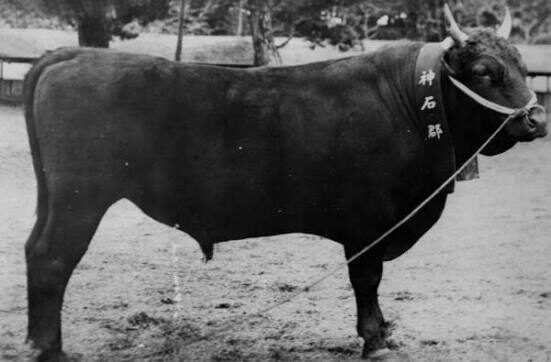
A historical record of a Jinseki breeding bull
A Jinseki bull recorded in its day as a breeding sire
1916

Prefectural livestock station opens in Jinseki District

The starting point that made the area a major production base for Hiroshima's breeding bulls.

1927

"Toyoman" draws the hearse at the state funeral

The honor of being chosen for Emperor Taisho's funeral rites spread the Jinseki name widely.

1982 & 1992

Two national championships at the Wagyu Olympics

"Dai-3 Shinryu no 4-go" and its offspring each took top honors, in the young bull and beef cattle categories.

2013 onward

The brand revived and redefined

A brand that had nearly disappeared was revived, with a new certification system put in place in 2015.

A "state funeral" (大喪の礼) is the national ceremony held on the death of an emperor. Since before the modern era, tradition held that the emperor's coffin be carried on a carriage or hearse drawn by oxen, a role of great ceremonial weight; the animal chosen for it had to be outstanding in build, coat, and temperament alike. That a single bull sent out from a small mountain district should stand at the center of a rite of state says something about just how highly Jinseki beef was regarded at the time.

What it means to raise cattle on a highland: Cattle are generally sensitive to heat, and in hot weather their appetite tends to drop, affecting weight gain and meat quality. Sitting at an elevation of roughly 400–700m, Jinseki Kogen has an average annual temperature in the low 11°C range, and is thought to see less summer heat stress than lowland producing areas along the Seto Inland Sea — conditions said to have made this a comfortable environment for cattle. The town once had highland pastureland, including the Sennyogahara plain, used for grazing cattle, and this history of making use of open land has long formed part of the soil in which Jinseki's cattle-raising culture grew.

Japan is home to many wagyu brands beyond Jinseki beef, each tied to a distinct regional climate and terrain — Matsusaka beef, Omi beef, Tajima beef and Kobe beef among them. Most of these lineages were raised in warmer coastal areas or basins, so Jinseki beef's character of having been raised in a cool mountain highland at roughly 500m elevation is one point of distinction. That said, the quality of meat is shaped not by climate alone but by a combination of bloodline, husbandry technique, and feed, and Jinseki beef's record, too, rests on the lineage descending from Toyoman together with generations of careful work by its producers.

The rite of an ox drawing the imperial hearse has old roots in Japanese history in its own right. In the aristocratic society of the Heian period, ox-drawn carriages (gissha) were the chief means of getting around the capital, and oxen were tied not merely to labor but to rank and formality as well. In imperial funeral rites, too, tradition long held that the carriage bearing the coffin be drawn by oxen. As the automobile spread in later eras, however, the conduct of such ceremonies is thought to have shifted increasingly toward motor vehicles, which means that the drawing of the hearse by Jinseki beef's "Toyoman" at the 1927 state funeral stands as one of the rare, and valuable, instances of ox-drawn imperial ritual from the modern era.
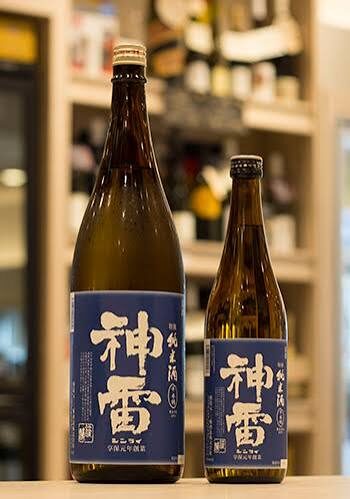
A brewery founded in 1716

The Sake "Shinrai" — a name drawn from thunder and from "Jinseki".

"Shinrai," the sake brewed by Miwa Shuzo in Yugi, comes from a brewery with a long history founded in the first year of Kyoho (1716), in the middle of the Edo period. The name "Shinrai" ("divine thunder") carries two layered stories: that lightning once struck the brewery long ago without serious harm, and that the name honors "Jinseki" ("divine stone"), the land where gods dwell. The very name of the brewery carries the faith of this land within it.

The brewery's main house and sake-brewing hall stand in the mountains of the Chugoku range, at an elevation of roughly 500m — said to make it the sake brewed at the highest elevation anywhere in Hiroshima Prefecture. The cool climate is thought to slow the fermentation of the mash, and the clear highland groundwater is another factor said to shape a sake's character — together, an environment unique to this land that has helped form the particular taste of "Shinrai."

In sake brewing generally, temperature is one of the factors that most shapes how fermentation proceeds. Brewing slowly in the cold of winter, a method known as "kanzukuri" or cold-season brewing, holds back the growth of unwanted bacteria while allowing fermentation to proceed gently at low temperature, and has long been considered a foundation of high-quality sake-making. Land at higher elevation tends to stay cooler year-round, which is said to give an advantage in controlling a brewery's temperature. Mountain groundwater, too, is generally low in minerals and closer to "soft water," a quality that is itself thought to shape a sake's aroma and flavor. Breweries set at high elevation are scattered elsewhere across the Chugoku mountains besides Shinrai's, and together they are said to have nurtured a mountain sake-brewing character distinct from that of the Seto Inland Sea coast.

Ino Tadataka and this brewery: Records show that in February 1811, the survey team of Ino Tadataka lodged at this brewery. Ino Tadataka received a shogunal commission past the age of 55 and, over the course of some seventeen years from 1800 to 1816, walked and surveyed the length and breadth of Japan on foot, producing the country's first precise map based on actual measurement, the "Dai Nihon Enkai Yochi Zenzu." A trace of that nationwide journey survives here, in a highland brewery.
A bottle of Miwa Shuzo's sake, Shinrai
"Shinrai" — sake brewed at a house 500m above sea level

From the highland fields

Highland vegetables, and the wisdom of preserving them.

With little flat land, Jinseki Kogen is dotted with terraced rice paddies cut into its mountain slopes, and rice farming, too, has long supported life here. Tomatoes, grapes, and other highland vegetables grown in this cool climate are the mainstay of the town's produce, prized for being picked fresh.

Maintaining terraced paddies takes more work than flat-land rice farming — managing irrigation channels, repairing stone retaining walls — and, as nationwide the number of people willing to farm them declines, terraced fields falling out of cultivation has become a widespread concern. Jinseki Kogen, too, continues efforts to preserve its terraces so that both the landscape and the farmland pass on to the next generation. The differing sunlight and water temperature from one sloped plot to the next are said to give each small parcel's rice its own subtle character, and these terraces, kept up at no small effort over generations, remain one of the defining scenes of farming in this land.

Highland Tomatoes

The gap between day and night temperatures is said to concentrate their sweetness; sold on being "picked fresh," highland tomatoes are one face of the town's produce.

Grapes (incl. Pione)

Grape-growing thrives in the cool climate too, with several varieties raised, including the large, richly sweet Pione.

Kogen Ruby (Kiwifruit)

A red-fleshed kiwifruit grown under the name "Kogen Ruby" has, in recent years, become known as one of the town's newer specialties.

Shiitake Mushrooms

Making use of the mountain climate and rich forest resources, shiitake and other mushrooms have long supported the local table.

Highland Ginger

Ginger grown on the cool highland is prized for its strong aroma and rich bite, and is used widely in processed foods.

Honey

Beekeeping also thrives, drawing on the highland's long flowering season, and local honey is a favorite souvenir from the town.

The range of processed foods is rich as well. Alongside time-honored products such as konnyaku, rice cakes, roasted rice, okaki crackers, honey, miso, amazake, pickles, senbei, and jam, the shelves also carry craft beer, retort-pouch beef and pork curries made with Jinseki beef, perilla (egoma) seeds, pudding, and yogurt — tradition and new ventures standing side by side.

Where to taste the highland today

Roadside stations and farm-direct markets.

To actually taste and bring home these gifts of the highland, the place to start is "Michi-no-Eki Sanwa 182 Station," a roadside station along National Route 182. It has a direct-sales market stocked with local vegetables in season and processed goods, an eatery serving regional flavors such as konnyaku dishes and udon or soba, and a café offering soft-serve ice cream — together forming a well-loved gateway to the town's food and farming.

Miwa Shuzo, too, keeps a shop at the brewery in Yugi, and a call ahead is sometimes said to be enough to arrange a purchase or a look around. Making the trip up to a brewery at 500m elevation, and tasting a cup while taking in the air of the place itself, is a way to enjoy this land found nowhere else.

Roadside stations and direct-sales markets like these are also places where the producer's face is visible. On shelves stocked by JA Jinseki Kogen and other local agricultural bodies, as well as by small individual growers, the vegetables, fruit, and processed goods reflect the turning of the seasons in this land in a way mass production never quite shows.

In closing

Food, too, carries the memory of a land.

The legend of a mountain where stars fell, devotion to a turtle-shaped stone, a gorge that bears the name of Taishakuten — and, alongside them, the lineage of a bull that once drew an imperial hearse, and a sake named for thunder and for "Jinseki." In Jinseki Kogen, it is not only in visible myth but quietly, at the everyday table as well, that the memory of how this land has faced its gods and great events continues to live.

Back to Home →