Home / Kagura & Festivals

04 — A dance to calm wild gods

A village of kagura,
calming the Kojin.

Devotion to the Kojin deity has long been passed down across the Bingo region. In the Toyomatsu district of Jinseki Kogen, Kojin Kagura said to date from the Anei–Tenmei era of the Edo period is still performed, and the Hakkasha Kagura, said to have been founded in 1098, is still danced today by seven kagura troupes.

A dragon costume used in a kagura performance
A dragon costume danced in kagura performances

What is Kojin devotion?

Entertaining wild gods, through dance.

Kojin is a deity believed to hold fierce, untamed power, thought to combine the character of a hearth god, a household god, and a local guardian spirit all at once. This devotion to Kojin has long been deeply rooted across the Bingo region (eastern Hiroshima Prefecture), and "Kojin Kagura" has been offered to the god in many places.

In the Toyomatsu district of Jinseki Kogen too, this Kojin Kagura is performed in spring or autumn. A program said to have begun during the Anei–Tenmei era of the Edo period (the 1770s–80s) is said to be handed down to this day. To calm a fierce god, entertain it, and turn its power toward protecting the community — this is what kagura is for.

Kojin has long been feared because its power was believed to swing sharply toward either good or ill. Handled incorrectly, or exposed to ritual impurity, the god was said to bring misfortune down on a household; properly enshrined, that same Kojin became an unusually reliable protector of the hearth and home against fire and illness. Fierce enough to hold great power, yet turned toward protection only once that power is purified and calmed — this duality sits at the very heart of Kojin devotion.

More than one kind of Kojin. The name covers several related figures depending on where and how the god is enshrined: the "hearth Kojin" (kamado-kōjin) guarding the kitchen fire, the "house Kojin" (yashiki-kōjin) guarding the homestead, and the "land Kojin" (ji-kōjin) guarding a community's fields and hills. Kojin is also widely enshrined as "Sanbō Kōjin," protector of the Three Treasures of Buddhism (the Buddha, the teaching, and the community of monks) — a sign of how deeply this devotion blends Shinto and Buddhist belief.

A worldview of fierce gods

Aramitama and nigimitama — a god becomes a guardian only once it is calmed.

Shinto has long held that a single deity can carry two opposing sides at once: the "aramitama" (rough spirit), fierce and capable of bringing misfortune, and the "nigimitama" (gentle spirit), calm and inclined to bless. Many festivals and kagura performances exist as rites meant to calm a god's aramitama and turn it toward its nigimitama.

Kojin devotion can be seen as a particularly clear expression of this pattern, widespread across Japanese folk religion, of entertaining and calming a fierce god rather than driving it away. Kojin figures found across the country are feared as powerful deities tied to fire and the hearth, yet properly enshrined, that same Kojin becomes a reliable guardian protecting a household from fire and illness — a duality found broadly in Kojin and hearth-god devotion across Japan, not only in the Bingo region.

That kagura centered on Kojin is handed down under names such as "Kojin Kagura" or "shinden kagura" in many places can be read as a mark of the wisdom of earlier generations, who chose to entertain this god with dance and music and turn its power toward protecting the community, rather than simply fearing and avoiding it.

The idea of "calming." Entertaining a fierce god with dance and music to win its favor, rather than keeping it at a distance, is an idea that surfaces throughout Japanese folk religion — not only in Kojin devotion, but also in goryō belief, which enshrined plague spirits and vengeful ghosts as "goryō" in an effort to pacify them. Kagura, too, belongs to this same lineage of practice.

The founding of the Hakkasha Kagura

In 1098, eight shrines raise a kagura.

Among the kagura traditions of Jinseki Kogen, the one with the oldest pedigree is the "Hakkasha Kagura" ("kagura of the eight shrines"). Tradition holds that in the second year of Joutoku (1098), the shrine families of eight manors, including Toyomatsu and Sasao, joined forces to found this kagura — in the late Heian period, more than 900 years ago.

The Hakkasha Kagura first developed as a kagura offered at the festival of Toyomatsu Tsuruoka Hachiman Shrine. It was later refined by incorporating elements of Bicchu Jindai Kagura, court kagura, and Ise kagura, and is said to have become, in both name and substance, a complete performing art.

What is intriguing is that these eight manors are said to have straddled a provincial border. Alongside Bingo-side communities such as Toyomatsu and Sasao, tradition holds that a community on the Bicchu side (present-day Okayama Prefecture) was also among the eight — and this geographic proximity may well explain why the Hakkasha Kagura absorbed elements of Bicchu Jindai Kagura so early on.

1098

Founding of the Hakkasha Kagura

In the second year of Joutoku, the shrine families of the eight manors including Toyomatsu and Sasao are said to have founded this kagura.

1770s–80s

Toyomatsu's Kojin Kagura

A program said to have begun in the Anei–Tenmei era continues to be handed down today.

Early modern era

Absorbing other kagura lineages

Elements of Bicchu Jindai Kagura, court kagura, and Ise kagura are incorporated, completing a distinctive style.

Today

Carried on by seven kagura troupes

Seven kagura troupes and the tourism association together support the culture as the "Jinseki Kogen Kagura Promotion Council."

Recent years

The Grand Kagura Joint Performance begins

Events such as the "Jinseki Kogen Grand Kagura Joint Performance," where all seven troupes can be compared side by side, start being held regularly.

A Hiroshima Prefecture Intangible Folk Cultural Property. Three related lineages handed down in Toyomatsu — Kojin Kagura, Hakkasha Kagura, and Kibi Kagura — are together designated an Intangible Folk Cultural Property of Hiroshima Prefecture. It is unusual for one small district to carry several distinct kagura lineages, each recognized in its own right, which says something about how deeply kagura took root in Toyomatsu.

What dresses the dance

Costumes, masks, music — the craft behind a single night's dance.

A night of Bingo Kagura begins with "shinji-shiki," ritual dance to purify the space, before moving into "nōmai," the narrative dance that tells a story. Roughly thirty nōmai programs are said to survive, and depending on the piece, a single dance can easily run over an hour — in the past, kagura would sometimes continue through the entire night.

Compared with the elaborate embroidered costumes seen in Iwami Kagura, Bicchu Kagura, or Chiyoda Kagura, Bingo Kagura keeps to a relatively plain look, generally built around a kariginu hunting robe or a lighter hitatare. Goddess roles wear festive kimono suited to the celebratory occasion. Masks are carved from wood, each one shaped by hand by local mask-carvers.

Music is built around taiko drums and flute, moving in step with the dancers' breath to shape the story's rhythm. Toyomatsu's own kagura preserves demanding set pieces such as "kirikimai," in which a warrior role spins rapidly on the spot again and again — a feat of stamina and skill that, combined with a narrative style rich in dialect and improvised comic exchanges, keeps audiences engaged throughout.

Ritual-heavy pieces also remain widely characteristic of Bingo Kagura as a whole, including "gogyō-sai," a rite that purifies the space with five-colored sacred wands, and "oshiki-mai," a spinning dance performed while balancing cups on a tray. Sources vary on exactly how much of this ritual repertoire survives within Toyomatsu's own kagura, but there is no doubt that pieces of this strongly ritual character are what keep Bingo Kagura an offering to the gods, rather than mere spectacle.

An offering that once lasted the whole night. Kagura was once an event offered to the gods through an entire sleepless night. Performances are now often broken into set time blocks for the convenience of audiences, but that original form — facing the gods through the night — survives most vividly in the strongly ritual pieces of traditions like Kojin Kagura and Hakkasha Kagura.

The myths that kagura performs

Ritual dance and mythic drama.

Kagura programs generally fall into two kinds. The first is "shinji-shiki," ritual dance meant to purify the space and welcome the gods — dances performed with sacred wands (toримоno-mai), or the dance of Sarutahiko, the deity who opens the way. The second is "shin'nō," dramatized mythic narrative, often drawn from Izumo mythology, performed with dialogue and gesture as a true performing art built on the gods' own stories.

Toyomatsu's kagura hands down both kinds. Its shin'nō repertoire has included "Kuniyuzuri," the story of the gods ceding control of the land, and the tale of Susanoo no Mikoto slaying Yamata no Orochi, the eight-headed serpent.
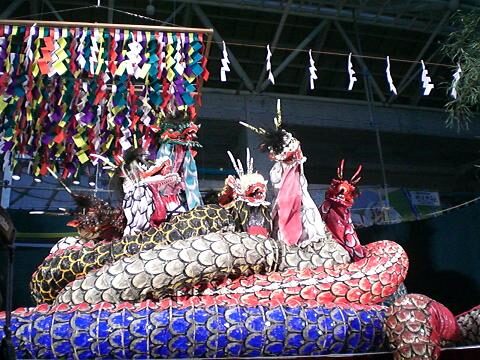
A dragon costume representing Yamata no Orochi
The slaying of Yamata no Orochi is one of kagura's most crowd-pleasing set pieces — the serpent-body costume in the hero image above belongs to this same lineage of props.

Across Japan more broadly, the myths kagura's shin'nō most often dramatizes are the creation of the land by Izanagi and Izanami, the story of Amaterasu withdrawing into the heavenly cave, and Susanoo's slaying of the great serpent — the central myths told in the Kojiki and Nihon Shoki. How much of Toyomatsu's own repertoire preserves an ancient form, and how much was reshaped in more recent times, varies by source, and tracing each program's exact lineage remains, in part, a task for future research.

Kagura of the Bingo lineage

Neither Iwami nor Bicchu — a Bingo way of dancing.

Jinseki Kogen's kagura belongs to the broader tradition known as "Bingo Kagura," found across eastern Hiroshima Prefecture. Other kagura traditions of the Chugoku region — Iwami Kagura from western Shimane Prefecture, and Bicchu Kagura from Okayama Prefecture — differ considerably in both origin and appearance, and should not be confused with it.

Bingo Kagura

Strongly narrative, carrying its stories forward through spoken dialogue, often with local dialect and improvisation that draws the audience in. Costumes and masks tend to be comparatively plain, and ritual-heavy pieces such as the Five Elements Rite and the Oribiki-mai spinning dance remain prominent.

Iwami Kagura (western Shimane — for comparison)

Fast-tempo drumming and flamboyant costumes, with a mechanized, many-jointed serpent as the centerpiece of its signature Orochi-slaying dance. It has grown into a major tourist attraction, but is a distinct Shimane-side tradition, not connected to Jinseki Kogen's kagura.

Bicchu Kagura (Okayama — an influence)

Retains a strongly ritual character, centered on oracle and trance-possession rites. It is one of the lineages said to have shaped the style of the Hakkasha Kagura, forming part of Toyomatsu's own roots.

Iwami Kagura has been widely covered on television in recent years and is often spoken of as though it stood for all Chugoku-region kagura, but it developed along an entirely different stream from Jinseki Kogen's own tradition. Bingo Kagura is better described as a lineage that has valued storytelling and ritual over spectacle.

Kagura you can still see today

When and where it is performed.

Kojin Kagura has traditionally been offered, in spring or autumn, at whichever household in Toyomatsu holds the year's turn as "kōjin-mochi" — the community's designated Kojin keeper — with the role rotating from community to community. Rather than being tied to a dedicated kagura hall, the troupe travels to that year's host household and dances there: a form of offering closely tied to what is known as "shinden kagura," and one deeply rooted in the local community.

The Hakkasha Kagura, by contrast, has always been offered at the festival of Toyomatsu Tsuruoka Hachiman Shrine. Today, too, the basic form remains a dance offered before the shrine, timed to the annual festival of the community's guardian deity.

More recently, events such as the "Jinseki Kogen Grand Kagura Joint Performance" have also brought together the dances of all seven kagura troupes, giving visitors the chance to enjoy several programs back to back at a single venue. Beyond visiting an individual community's own festival, attending one of these joint performances lets you compare Toyomatsu's three lineages — Kojin Kagura, Hakkasha Kagura, and Kibi Kagura — side by side. Timing and venue change from year to year, so it is worth checking with the Jinseki Kogen Tourism Association or the Kagura Promotion Council before visiting.

Within Hiroshima's wider kagura scene. Hiroshima Prefecture as a whole has an unusually deep culture of kagura, with numerous troupes holding regular performances and joint shows throughout the year. Within that scene, Toyomatsu's kagura stands out less as staged entertainment for tourists and more for how vividly it preserves its original form as an offering to the community's guardian gods.

Why it has been carried on

Mountain gods and village gods alike, bound together by dance.

The star deity of Mt. Hoshinokoyama, the stone god embedded in a place name, Taishakuten of Taishakukyo Gorge — layer upon layer of devotion to various gods remains across Jinseki Kogen. Kagura may well have been the most intimate device for binding people to these unseen gods.

Precisely because every highland community had its own shrine, and every shrine its own kagura troupe, an art with a founding legend more than 900 years old continues unbroken even now, as depopulation advances. What has been passed from dancer to dancer, across generations, is surely not just choreography, but the very memory of how this land has honored its gods.

Read about Legends & Historic Sites →